Friday, April 22, 2016

Things I (Re)Learned Sailing In The BVI

And just like that, my much-anticipated return to the Caribbean has come and gone. I'm somewhat settled back into my regular routine and ready to share some lessons.

1. Pack light. I've heard this before and I think I did a reasonably good job packing light on clothes, but my camera bag was another story. I brought just the right amount of gear for my Nikon (probably because I don't really have any gear for my Nikon apart from a charger and a pair of lenses), but I totally over-packed on GoPro stuff. My CamelBak had never felt heavy before, but this time it was stuffed to the gills and I definitely felt it. This over-packing was accentuated by the fact that being sick for a few days kept me from doing much of the snorkeling that I had planned on using it for. Urk. One of the first things I did when I got home (aside from sleeping) was cutting down my standard GoPro kit to something more minimalist for future adventures.

2. "Travel Days" are an absolute Godsend. The last time Sara & I sailed in the BVI, we arrived the day before we set sail and we spent that night on the boat. "First night on the boat" is a common service offered by many charter companies, but after a long day traveling, one more night in a real bed, with a real shower in the morning, would have been nice. And on our last day, we had to drop off the boat, clean up, pack up, and make a flight home all in one day. Needless to say, that last day on our last trip was a blur. With these lessons in mind, I scheduled a "travel day" on either end of our charter this time around; we stayed at a hotel at the marina the night before and the night after our charter. Not only did this mean we were far less rushed and much more rested, since our charter company had a busy day scheduled on our return day and we didn't have to catch a flight, they actually gave us a few more hours out on the boat for free. Score!

A photo posted by Ben Cushwa (@nautography) on

 
3. Don't panic! The wind on our third day (leaving Spanish Town for North Sound) was erratic and gusty, so the sail up and around Virgin Gorda was a bit...sporty. Once we cleared Mosquito Island to make our turn south into the Sound, we tacked the boat across the wind (which was out of the ENE). After tacking, the boat refused to point anywhere close to the wind and we were getting heeled over pretty badly. My guess was that we had hit a current that was pushing us off course. After fighting this for a moment there was a loud pop and the helm jerked over away from the wind. We regained some of our pointing ability, but the helm had gotten really sloppy; I would spin one wheel half a turn before the other wheel turned in kind or I felt the rudder engage. Immediately I knew that something in the steering gear had broken fighting that current. I decided to drop sail and motor our way into the Sound. I contemplated breaking out the emergency tiller, but I felt had sufficient helm authority, albeit barely, to navigate the entrance to the Sound. By the time we picked up a mooring ball at the Bitter End Yacht Club, my arms were exhausted and looking back I was surprised by how quickly and calmly I handled the situation. Experience pays! The next day, I found the access panels for the steering gear and, sure enough, one of the pulleys had broken. I called the charter company and they had someone out the next morning to fix it. To Dufour's credit, they engineered their steering system with a particular failure mode in mind (the pulley wheels were plastic, and therefore the weakest link) and ensured that that failure mode was easy to access and repair. Well done!

4. I am not a fan of self-tacking foresails. Our Dufour was equipped with a rather well-thought-out self-tacking foresail system that meant the boat could practically sail itself once you got it underway. Tacking was, as expected, as simple as turning the boat through the wind and both sails simply moved over to the new leeward side. Sailing upwind or on a reach, I rather enjoyed the system, even though it did lose some power because of the smaller foresail required. However, sailing downwind was kind of a pain. It was damned-near-impossible to get the foresail to stay on one side of the boat and it was difficult to trim it properly*. While I appreciated the ease of sailing upwind, during our one downwind leg I wanted nothing more than the conspicuously missing pair of cockpit winches and a few extra lines to get that damned sail set properly. Again, kudos to Dufour for making the best of the design principle (and for making the boat available for sale with a traditional foresail rig), but it's a design principle I'm not personally fond of.

5. Be flexible. Our original plan had been, roughly, to sail from East End to Cooper Island, then to Spanish Town, then to North Sound for at least two days, then to Trellis Bay, then wherever the wind took us (within reason) until we had to get the boat back to East End. Our steering casualty tacked on one day in the North Sound, and me getting sick tacked on another. Even though we spent twice as much time in North Sound as we had originally planned, we still got to Trellis Bay, and actually ended up in a great position to make a beeline back to East End on our last day through choppy seas and gusty wind. Had we been further away, that last day would have been far less pleasant. Having that extra time built into our schedule meant there was virtually no stress added by waiting for repairs or me sleeping a day because the blessed cold meds knocked me out while they worked. While you can do a whole circuit of the BVI in a week, I would recommend doing it in two or only doing a partial circuit in a week. The extra time is worth it, and not hitting two or three stops in one day means the trip won't be a blur for you.


A photo posted by Ben Cushwa (@nautography) on


* As much as I present myself as a cruiser, racing sailboats has broken me. I may be okay with meandering wherever the wind may take us, but I want to get there efficiently dammit!

Wednesday, April 20, 2016

The Gods of Docking

On our recent BVI trip, we were docked comfortably at a slip at Leverick Bay on the North Sound of Virgin Gorda. Sara and Momma were making breakfast and I was up on deck enjoying the morning when I saw a sailboat pulling into a slip on the opposite of the pier. They seemed to be coming in rather fast so my gaze stayed fixed on them to see just how abruptly the skipper was going to slow down. The bow of the boat cleared the finger pier and then the boat slowed somewhat but it was still coming in faster than I would consider typical. I began wondering if this was some hotshot skipper trying to show off or some poor sap who didn't know what they were doing.

It was then that I noticed that there was no skipper. The boat was drifting in from the sound and, purely by the most blind of luck, managed to come in, bow first, almost directly into an empty slip. My mind raced for a moment at the near-astronomical odds of this happening. Had the wind or current been moving in any of an infinite number of other directions, this boat would have been washed up on rocks, drifted into one of the buildings on the dock, or crashed into one of the other boats at the dock.


A photo posted by Ben Cushwa (@nautography) on


I quickly put aside all thought of the odds and by the time my feet hit the pier in order to help secure the drifting vessel*, I felt a low thump as the bow hit the pier. Myself and several others managed to wrangle the boat into something of a secure position using lines that were handy, but with no fenders and a bit of a swell on that side of the pier, the longer this boat was there the more likely it was going to sustain some damage. I say "some damage" because the impact with the pier managed to leave only the slightest of dings on the bow; the soft wood on the edge of the pier had absorbed most of the impact, and even the damage to that was minimal. Rather incredible when you consider the circumstances.

Those of us on the dock securing this wayward boat wondered what had happened to it and where its crew were when we noticed that there was a line hanging off of the bow. Someone fished the other end out of the water and discovered that it had been the pendant of a mooring ball and that it had likely been cut by a propeller. Our guess was that someone had taken a dinghy too close, damaged the line, and left the boat to adrift and at the mercy of the wind and tide.

With the marina dockhands on the scene, I left them to their work, still amazed at what  had just seen. Sara & Momma didn't almost didn't believe me when I told them over breakfast. The owners must have been nearby because the boat was gone within an hour or so.

My takeaways from this episode: be careful with your dinghies while in a mooring field...and whatever Boating Gods the owners of that boat pray to seem to be highly effective!


*This was one of those times that I opted to forego snagging my camera to catch the action and just go help. I did take pictures of the minimal damage afterwards, but the boat was gone before I had a chance to offer to share them with the owners. Oh well.

Tuesday, March 29, 2016

New Toy: Nikon D3100

Apologies (again) for the lack of posting. It seems that I generally only have time to do two Nautography-related things at a time, and as of late that has largely been shopping for cameras and getting ready for our upcoming BVI trip. (Less than a week away!) Curse you day job!

As someone who's budding social media career depends greatly on taking pictures, I have found myself lacking in the camera department for some time. Most of my experience snapping pics has, sadly, been done with just a smartphone. They're compact and easy-to-use, they're obviously great for uploading images, and doing something as simple as turning on the gridlines on your display make lining up quick shots a breeze, but they are fundamentally limited in what they can do in terms of, you know actually taking pictures.

I addressed part of this limitation last summer when I bought my GoPro Hero4 Silver. (In hindsight, I should have written a post about it at the time, but I got it just before several trips so I was busy posting about them instead. Oh well.) In my GoPro, I gained the ability to shoot while wet (which is kind of important on a boat), take higer-resolution images (my trusty Samsung Galaxy S4 Mini is definitely showing its age in this department), and its wide-angle lens affords me the opportunity to do things take closeups of sailboats without clipping off the mast and also capture good panoramic shots. And yes, it does shoot amazing action videos too and the ability to mount it places and control it remotely is incredibly handy. But as I soon learned, even with my GoPro supplementing my GS4m, I was still largely limited to taking non-landscape pictures of subjects relatively close to me. I referred to that limitation as "the boatlength rule" because I could really only take good pictures of things within about one boatlength* of wherever I was.

This winter, I started on my quest to fill yet another gap. I spent a lot of time asking around and doing some research. While the choice of my GoPro was practically a no-brainer, my next choice for a camera was far less clear. Should I go with a waterproof, ruggedized, point-and-shoot like an Olympus TG-4? Or should I go with a more conventional-yet-less-boat-friendly digital camera like a DSLR or mirrorless? Should I go high end or something with fewer bells and whistles? WiFi enabled? GPS enabled? There were just so many things to consider.

Well, as the title indicates, DSLR won. Specifically, a factory-refurbished version of an older DSLR won. The Nikon D3100 had almost all of the things I was really looking for: manual controls so I can broaden my photographic horizons, exchangeable lenses so the camera can grow with me as I learn, and a low pricetag ($270 with 18-55mm lens and all factory accessories) that went a long way towards sealing the deal. It uses the same media (MicroSD cards with an adapter) as my GoPro and my GS4m, which greatly simplifies logistics. And to top it off, even though it's not WiFi enabled, I can just drop the MicroSD card directly into my GS4m to post pictures in the field if I want to.

Not too shabby for a camera that was released over five years ago.

A photo posted by Ben Cushwa (@nautography) on


Given the cost of a typical 18-55mm lens, I pretty much only paid $170 for a fairly modern and capable Nikon DSLR. No, it's not brand new and no, it's not top of the line, but as someone who's just learning neither of those things matter to me right now. I can do far more than I could before, and I can do it without having broken the bank, so that's pretty much perfect for me.

The one thing** I sacrificed, and the one advantage that the Olympus I mentioned earlier had over my Nikon, was water resistance. The Olympus would have been wonderful for taking underway (and even underwater) pictures, but it would have been far more limited while working afloat (i.e. docked, moored, anchored, etc.) or ashore. Since I already have some underway/underwater capability in my GoPro, I opted for the camera with more growth potential (both in the camera and in my abilities) with the understanding that I wouldn't necessarily be able to use it while underway. Had I gone with the Olympus, I feel like I would have just gotten another GoPro-like camera, which is really not what I was looking for.

Check back in here (and on Instagram) for pics from my trip, but for now, here's a few teasers:

A photo posted by Ben Cushwa (@nautography) on


A photo posted by Ben Cushwa (@nautography) on


I also have it on good authority that someone took it upon themselves to order me a 300mm telephoto lens as an early birthday gift and had it shipped here. It should arrive just in time to take some fabulous pics in the BVI. THANKS MOM & DAD! B^)

UPDATE: I've got a few weeks of shooting in with my D3100 and I'm now convinced that it is an ideal camera for me at the moment. Coupled with the fantastic Nikon 55-300mm telephoto lens, a lightweight bag, and a few extras, I've got a kit that is light, small, and capable. I'd eventually like to get a few prime lenses (one each for general use & low light, portraits, and wide-angle), but I think what I have right now will work just fine for a while. And even when I do eventually snag a few prime lenses, I'm such a fan of keeping my bag light that I'll likely only ever bring two lenses with me at a time: one on the camera and one spare.


A photo posted by Ben Cushwa (@nautography) on

Here are some specific things about the D3100 that I like and dislike.

PROS:

Size/Weight: I didn't realize it when I bought it, but the D3100 is one of the smallest and lightest DSLRs available. It's not much bigger (sans lens) than many mirrorless cameras. This makes it ideal for travel use and lugging around all day.

Ergonomics: I can snap pictures, switch modes, and make some basic adjustments with just my right hand. This is very useful on a boat when I'm often using my other hand to hold on to said boat. Nikon's higher-end cameras all have their mode dials on the opposite side of the camera so they require two hands. I added a hand strap for extra security when shooting one-handed.

Capacity: The D3100 has an older, lower-resolution 14MP sensor. It's immediate successor, the D3200, and several other Nikons released around the same time, have 24MP sensors. Unless you are using top-grade professional lenses, digitally zooming your pictures, or blowing prints of your pictures to several feet or larger, 14MP is plenty. I save all of my pictures as full-resolution JPEGS and RAW files, and between the smaller file size of the older sensor and the recently available 64Gb SD cards I have never even come close to running out of space. My whole week in the BVI only took up a little over 5Gb.

Cost: You can find refurbished models with a standard 18-55mm kit lens for under $300. New ones can still be had for under $400. That's hard to beat.

CONS:

Speed: Powering up and taking single shots seems quick enough, but in continuous shooting mode the D3100 really struggles at about 3 frames per second. This isn't really quick enough to get an action sequence. You can increase this by not saving the RAW file and opting for smaller JPEGs, but not much or for long.

Viewfinder: I like that the viewfinder isn't cluttered (all you see are your image and 11 small auto-focus points), but shooting on my GS4m and GoPro definitely spoiled me to using grid lines to compose my shots. I've tried to use the AF points to help with shot composition and horizon leveling, but it doesn't seem to be as effective. Fortunately, it's easy enough to digitally rotate images in post-processing. (Note: gridlines are available if you shoot using the LCD screen, but the disadvantages of doing that far outweigh the benefits of the gridlines.)

Availability: The D3100 has been discontinued by Nikon, so they're not always available new or used. Fortunately, the D3200 is still in the lineup and it has many of the same advantages, especially if you save your images at less-than-maximum resolution, but it does cost more.

* For reference, I typically sail on boats 40ft in length or less.

**I wouldn't really call this a sacrifice, but I was a bit disappointed that it wasn't shiny and red like in the Amazon listing. At this price though, I'm not going to complain.

Friday, January 15, 2016

Review: SailChecker

I didn't start Nautography with the intention of reviewing businesses related to my sailing experiences, but after my recent experience with SailChecker, I feel compelled to change that.

SailChecker is a yacht chartering service based in the UK that I have heard good things about, so it seemed natural to give them a go when booking our upcoming sailing trip to the BVI. After putting in inquiries with several charter services, SailChecker got back to me with an offer that was seemingly too good to be true: a week in early April on a 2006 Dufour 385 Grand Large for $2,000 US.

That price is not a typo.

The other offers we had gotten were closer to the $3,800 US range for older, less well-built boats. Needless to say, Sara & I jumped on the opportunity as that price was far less than we were expecting to pay.

The old saying goes that if something seems too good to be true then it probably is. Alas, this was the case with our offer from SailChecker. I received an e-mail from Chris Lait, the CEO of SailChecker, apologizing profusely and explaining to me that the offer had been generated as a result of a technical glitch in one of their databases and extending me another offer. Admittedly, Sara & I were both torn about proceeding with SailChecker at this point: despite their good reputation in sailing circles, their first impression with us had not been all that impressive.

Then, something rather unexpected happened. I got a phone call from Chris. He explained to me the situation in more depth and said that he was willing to work with me to get us on a boat. We talked for a while and I told him specifically what we were looking for and he said he was certain he could help us. That phone call, not from the employee who had made a mistake, but from the CEO of the company, changed my mind. It spoke volumes about his professionalism and the lengths to which SailChecker would be willing to go to meet our needs.

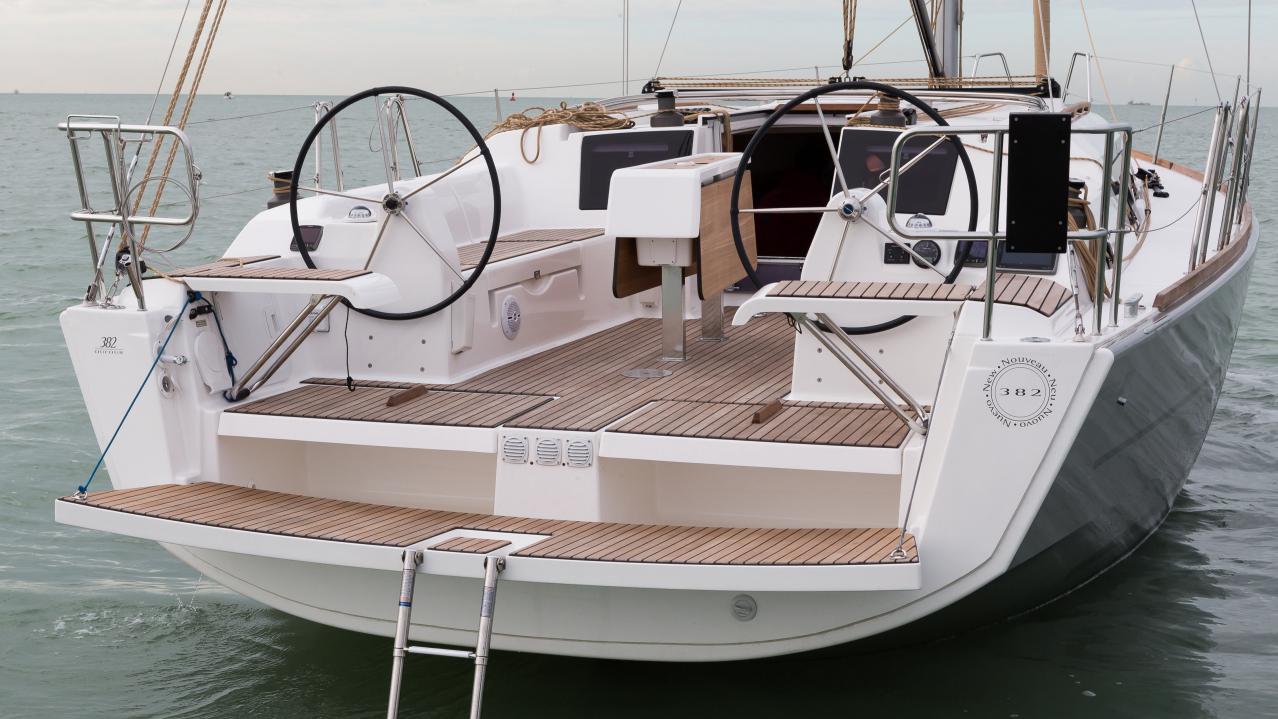
We exchanged e-mails over the next few days (including negotiating a refund policy that we had been offered from another company) and finally settled on an offer. In the end, we got a much newer Dufour, a 2015 Dufour 382 Grand Large, for a price that, while understandably higher than the initial offer, was still less that the offers we had gotten from other companies for older boats. Although we're still a few months out from the trip, everything since that initial database error has been smooth sailing and I suspect it will remain that way.


Dufour 382 Grand Large, stock image


UPDATE: 

On March 21st, less than two weeks before our charter was scheduled to start, I came across a booking mistake that could very well have jeopardized our trip. Since I caught the error in advance, we were able to make the necessary adjustments and instead of a potentially ruined trip we were only inconvenienced.

I realize that this situation was caused by an error that is probably very rare. However, it is the second such rare error that I have experienced while booking the same trip with SailChecker. Both times they compensated me for the errors, and that compensation was fair and much appreciated. Although I still think very highly of SailChecker's staff because of the lengths they went to in order to do right by me, I will likely not be using SailChecker's services again in the future because, quite frankly, third chances are not something I grant lightly.

Tuesday, December 29, 2015

Dinghy Salvage Artist

Something I'm rather fond of doing with my daughter Abby is wandering around to a few "beaches" in Annapolis in search of, well, stuff. Driftwood, shells, and various bits of flotsam are our usual haul. But one recent Saturday we came across something a bit bigger.

We pulled up to the Ellen O. Moyer Nature Park at Back Creek, which has a little cove off of Back Creek where things tend to wash up, near dusk. There's less driftwood and more trash this far up the creek, but it's still fun to check. But this time what we found wasn't trash, it was a derelict dinghy. It was half-deflated, only barely floating, and judging from the amount of accumulated dirt and grime had been adrift for some time. It still had a painter* that was within reach of the shore, so I pulled it in out of the water.

My immediate concern was to prevent it from becoming a hazard to navigation, but there wasn't anything sufficiently heavy to anchor it. Given enough time I likely could have improvised something, but since it was going to be getting dark soon I had to settle for pulling it ashore and hoping that the tide didn't carry it out of the cove. My other concern was seeing if I could identify who the owner was and possibly returning their lost dink to them, so I took several pictures of the craft, including its Maryland registration number, while I still had light.

The next morning, I returned to the cove with some equipment in order to properly secure the wayward dinghy until I could identify its owner. As I had suspected it would, the tide had shifted its position but fortunately it hadn't gone far. Now it was on the opposite side of the cove very near to the A-dock of Port Annapolis Marina. With a little effort (and only a slight bit of cold water down the top of one waterproof boot), I managed to get the dinghy ashore and properly secured so that it wouldn't drift out into the creek and become a nuisance.

A photo posted by Nautography (@nautography) on

On Monday, I contacted the Maryland Department of Natural Resources to inform them of the situation and ask for assistance with contacting the owner. Shortly thereafter, the owner called me directly to confirm the condition and location of the dinghy.

I guess now I can add Amateur Dinghy Salvage Artist to my resume right beside Amateur Salvage Diver.

*In nautical terms, a painter is a long bow line attached to a dinghy or other small craft. There were no paint-brush-wielding people attached to the dinghy.

Monday, December 28, 2015

Landlocked

As is wont to happen to a sailor who doesn't own their own boat, I have spent most of the latter half of 2015 on dry land. I've still been posting photos on Instagram, learning how to turn driftwood into something resembling art, and I even had a random dinghy salvage adventure that almost got its own post (and probably should have now that I think about it), but I haven't actually been sailing or doing much sailing-related stuff*. Such a pity.

Well, fortunately that will be changing in the near future. I'm in the process of booking a charter sailing trip in the BVI for Sara & myself and her mom Cathy for this coming April. I've been taking notes as I go along and plan on 'blogging the entire process from booking, through travel preparations, and the trip itself. The Annapolis racing circuit should also be getting back into gear around that point, so I'm looking forward to a very eventful 2016.


*Note to self: I posted back in July about having time to process a bunch of pictures and videos. July. Half a year ago. I must remedy this....

Wednesday, August 5, 2015

Sailing Blind

I am below deck in the cabin of a gently rocking sailboat. On the table in front of me is a chart, an array of plotting tools, a calculator, and a stopwatch. My only information regarding the outside world is coming to me via the companionway from our helmsman, Andy. He reads me off our speed, heading, and depth sounder readings intermittently and lets me know if he can see anything within 100 yards or so in the water. On deck, assisting Andy in keeping watch, is Mark.

My task is simple: navigate a 37' sailboat up the South River without grounding us using only a 100 yard sphere of information from the outside world, a chart, some basic tools, and my skill as a navigator.

Courtesy of NOAA

At the beginning of this exercise, the Fl (2+1) R 6s* buoy off of Saunders Point was directly off of our port beam and we were in 18 feet of water. Our boat draws about 6 feet of water, so my goal is to keep us in waters deeper than 10 feet; this not only allows me some margin of error, it also allows me to roughly follow the 12-foot depth contour on the chart if need be. I spend a moment looking at the chart and devise a plan. I need visible landmarks to verify our position, so I decide to plot a course that takes us close to navigational markers as we move up the river.

My first waypoint is the #4 red buoy (Fl R 2.5s), which is to our north near the mouth of the river. The water shallows up very quickly beyond the buoy so to allow for some margin of error I plot our course to pass slightly west of the buoy. According to my calculations, it should take about 9 minutes until the buoy is visible.

With our course plotted and the instructions relayed to Andy, all I can do is wait. To help pass the time, I inquire occasionally as to our depth but in this region the bottom is relatively flat so it varies little as we progress. 9 minutes come and go and there is still no sign of the buoy. My heart starts beating a little bit faster and I quickly review my calculations. Had I forgotten something? Were we off course?

Before I start to doubt myself too much, Andy yells down to me that he sees the buoy just off of our starboard bow, right where it should be. I make a quick mental note of the extra time it took; was that due to tidal currents, which I hadn't accounted for, or was it just an error in estimating our initial position? But those matters would have to wait because I needed to relay our next leg to Andy, which takes us northwest straight to the #5 green buoy off of Turkey Point.

There is a shallow bar between our current position off of red #4 and the next waypoint. My first instinct is to plot a course around the bar, but instead I plot a course right over it. Placing faith in our depth sounder and the quick reflexes of our helmsman I decide to use the bar as a way of establishing our position. We are only making about 5 knots through the water, so once our depth sounder reads 10 feet Andy can simply turn us to starboard to clear the bar. After we round the bar we'll have a reasonably good fix on our position.

At least, that's my plan.

Andy steers his course to the Turkey Point buoy, and I wait. After a few minutes, the water beneath us starts shallowing up.

14 feet.

12 feet.

10 feet. As per my instructions, Andy turns us 10 degrees to starboard to clear the bar.

9 feet. I have Andy turn us another 10 degrees.

8 feet. I have Andy turn us another 10 degrees, and I start to wonder if my plan to use the bar as a fix was too bold of a move. If we are further south on the bar than I planned we would have to make a much larger course correction than I had allowed for.

8 feet.

9 feet.

10 feet.

12 feet. I have Andy begin to turn us to port to resume our course to the Turkey Point buoy and breathe a quiet sigh of relief. My plan had worked, we were back on course, and I now had a much better fix on our location.

This goes on for another several legs and we make it about halfway from the mouth of the river to the bridge at Edgewater. Over time, Andy & I fall into a steady rhythm and sailing the boat blind seems almost natural. My calculations get more and more accurate so that we hit our last waypoint almost exactly when I think we should. At this point, Mark comes back the cockpit from his position on the bow and congratulates both of us on a job well done.

It's not actually foggy out; it's a perfectly clear day and Mark & Andy both had well over a mile of visibility and access to a GPS chartplotter in the cockpit. Mark isn't just a crew member keeping watch, he's a Royal Yachting Association sailing instructor and Andy & I are his students. This whole experience had been a teaching exercise meant to simulate sailing under poor visibility conditions with limited outside information. I can't speak for Andy's experience on the helm, but this certainly increased my confidence as a navigator.

If you are a sailor and ever have occasion to try blind navigation under good visibility conditions, I highly suggest that you try it. It is a bit stressful, but also very rewarding.


*This is nautical chart lingo for a buoy with a flashing red light that repeats a 2 + 1 flash pattern every 6 seconds.